Building consistent routines can feel like an uphill battle, but a well-designed bullet journal habit tracker acts as your personal accountability partner, quietly nudging you forward. Far from being a mere checklist, these trackers are powerful visual tools that document your journey toward self-improvement, helping you transform intentions into ingrained actions. Whether you’re aiming to drink more water, meditate daily, or finally tackle that overflowing inbox, exploring various habit tracker examples can spark inspiration and show you just how adaptable this system can be.
At a Glance: Your Guide to Bullet Journal Habit Trackers
- Personalize Your Progress: Discover how to tailor habit trackers to fit your unique goals, from daily rituals to yearly milestones.
- Master Design Principles: Learn about minimalist layouts, themed creations, and functional grids that make tracking engaging and effective.
- Track Any Habit Imaginable: Explore a comprehensive list of specific habit examples across vital life categories.
- Implement Winning Strategies: Get practical tips to set up your tracker for success and ensure your habits stick for the long haul.
- Overcome Common Hurdles: Find answers to frequently asked questions about maintaining consistency and adapting your tracking approach.
The Power Behind the Pen: Why Track Your Habits?
At its heart, a habit tracker is a simple system: you mark off each day you complete a desired action. This seemingly small act triggers a cascade of psychological benefits. It’s not just about ticking boxes; it’s about building tangible evidence of your commitment.
Consider the humble “X on a calendar” method. Each mark represents a conscious choice, a moment of discipline. Over time, these individual marks coalesce into a visual chain, a streak that motivates you to keep going. This basic concept extends to intricate bullet journal spreads, offering:
- Accountability: Knowing you’ll mark it down fosters a sense of responsibility.
- Motivation: Seeing your progress visually is incredibly inspiring.
- Self-Awareness: You start noticing patterns, triggers, and areas needing adjustment.
- Goal Breakdown: Large aspirations become manageable daily or weekly steps.
- Productivity: The satisfaction of tracking fuels consistent engagement.
- Self-Discipline: Regular commitment to your tracker strengthens your willpower.
Before we dive into the creative habit tracker examples that can bring your bullet journal to life, it’s helpful to understand the vast landscape of habits worth cultivating. If you’re looking for an even broader perspective on what kinds of routines and goals you can document, Learn what habits to track. Now, let’s get into the specifics of how to track them.
Real-World Habit Tracker Examples: What to Track
A bullet journal’s flexibility means you can track virtually anything. The key is identifying what truly matters to you and then finding a way to log it consistently. Here are specific habit tracker examples categorized by common life areas:
Daily Rituals & Tasks
These are the bedrock of any productive day, often small actions that collectively make a big difference.
- Morning Routine: Make bed, meditate 10 minutes, drink a glass of water, journal 5 minutes, quick stretch, review daily tasks.
- Evening Wind-Down: Read 20 pages, prepare clothes for tomorrow, do dishes, review day’s gratitude, no screens after 9 PM.
- General Daily Habits: Drink 8 glasses of water, cook a healthy meal, walk 30 minutes, practice a language, quick tidying task, take medication.
Weekly Responsibilities & Check-ins
These habits ensure things run smoothly on a slightly larger cycle, keeping your life in order.
- Home Management: Laundry day, grocery shopping, clean bathroom, plan meals for the week, take out garbage/recycling.
- Personal & Financial: Review personal finances, attend fitness class, schedule social time, check project deadlines, self-care activity (e.g., face mask).
- Relationships: Call a family member or friend, plan a date night, send a thoughtful message.
Monthly Reviews & Planning
Monthly tracking helps you maintain long-term goals and prevents important tasks from slipping through the cracks.
- Financial Health: Budget review, pay bills, track savings/investments, review subscriptions.
- Personal Growth: Set new goals, review previous month’s progress, attend a workshop, read a new personal development book.
- Home & Health: Deep clean one area of the house, health check-up, home maintenance (e.g., change air filter), plan special occasions.
Annual Milestones & Preparations
Though less frequent, these habits are crucial for foresight and long-term well-being.
- Financial & Legal: Tax preparation, annual financial review, update wills/documents.
- Health & Wellness: Annual physical/dental check-ups, vaccine boosters, review insurance.
- Personal & Travel: Annual goal setting, vacation planning, review yearly achievements, update emergency contacts.
Financial Habits
Gain control over your money by tracking conscious spending and saving habits.
- Spending Control: Track all expenses, avoid unnecessary spending (e.g., no takeout coffee, pack lunch), log “no spend” days.
- Savings & Debt: Log savings contributions, debt payments, investment reviews.
- Awareness: Track income sources, log donations, review monthly budget adherence.
Health & Self-Care (Physical & Mental)
These are arguably some of the most impactful habits for overall well-being.
- Physical Activity: Exercise 30 minutes, 10,000 steps, yoga/stretching, rest day, physical therapy exercises.
- Nutrition: Eat 5 servings of vegetables/fruits, drink only water, meal prep, avoid fast food/sugar/alcohol.
- Sleep: 7-8 hours of sleep, in bed by 10 PM, no screens before bed.
- Hygiene & Grooming: Floss teeth, shower daily, skincare routine (wash face, apply moisturizer), hair care.
- Mental Health: Meditate 15 minutes, gratitude journaling, positive affirmations, practice breathing exercises, limit social media, therapy sessions, self-care activity (e.g., bath, reading).
- Body Metrics: Track weight, water intake, caffeine intake, mood, energy levels, period/ovulation cycle, headache frequency.
Relationships & Social Connections
Nurturing your connections is a habit that pays dividends in happiness.
- Connecting: Call a parent/friend, send a thoughtful text, plan a date night/social outing, send a thank-you note.
- Giving: Compliment someone, offer emotional support, volunteer time.
- Presence: Be fully present during conversations, schedule quality time with loved ones.
Hobbies & Pastimes
Making time for joy and personal interest is vital for a balanced life.
- Creative Pursuits: Practice an instrument, draw/paint, write, work on a craft project, learn a new recipe.
- Consumption: Read a book, watch a documentary, listen to a podcast, discover new music, visit a museum.
- Learning: Research a new topic, practice a language, attend a workshop related to a hobby.
Personal Growth & Learning
Continuously evolving is a cornerstone of a fulfilling life.
- Education: Read non-fiction, watch educational videos, complete a course module, learn a new skill.
- Mindset: Practice positive thinking, affirmations, gratitude, self-reflection, step out of comfort zone.
- Development: Journaling, goal review, challenging negative self-talk, teaching others, spending time without social media.
Environment & Sustainability
Small actions for the planet, tracked consistently, can lead to a significant impact.
- Reduction: Recycle daily, reduce waste (e.g., bring reusable bags), conserve energy/water, plastic-free swaps.
- Conscious Choices: Compost, use eco-friendly transportation, support local/sustainable businesses.
- Engagement: Participate in environmental initiatives, learn about climate issues.
Travel & Exploration
Tracking travel can turn wanderlust into concrete plans and memories.
- Planning: Research new destinations, add to travel bucket list, plan upcoming trips, save for travel.
- Documenting: Log places visited, track travel expenses, note highlights/memories.
Home Organization & Cleaning
Maintaining a tidy space contributes to a clear mind.
- Daily Tidy: Make bed, wipe counters, put away laundry, manage emails/messages.
- Weekly Deep: Clean bathroom/kitchen, vacuum/mop, change sheets, water plants.
- Periodic: Organize a drawer/closet, clean out fridge, wash car, pay bills.
Pet Care
Ensuring your furry (or scaled/feathered) friends are well cared for.
- Daily: Feeding, walking, playtime, medication.
- Weekly/Monthly: Grooming, litter box/cage cleaning, vet check-ups, training sessions.
Physical Activities & Sport
Directly track your fitness journey and athletic goals.
- Workout Logs: Specific exercises, reps, sets, duration, distance run/cycled, yoga sessions.
- Recovery: Stretch, foam roll, rest days, hydration.
- Progress: Track personal bests, attendance at classes, new skills learned (e.g., a specific yoga pose).
Habit Tracker Examples: Designs and Layouts for Your Bullet Journal
The beauty of the bullet journal is that your tracker can be as simple or as elaborate as you desire. Here are popular design habit tracker examples that you can adapt:
The Classic Calendar Grid
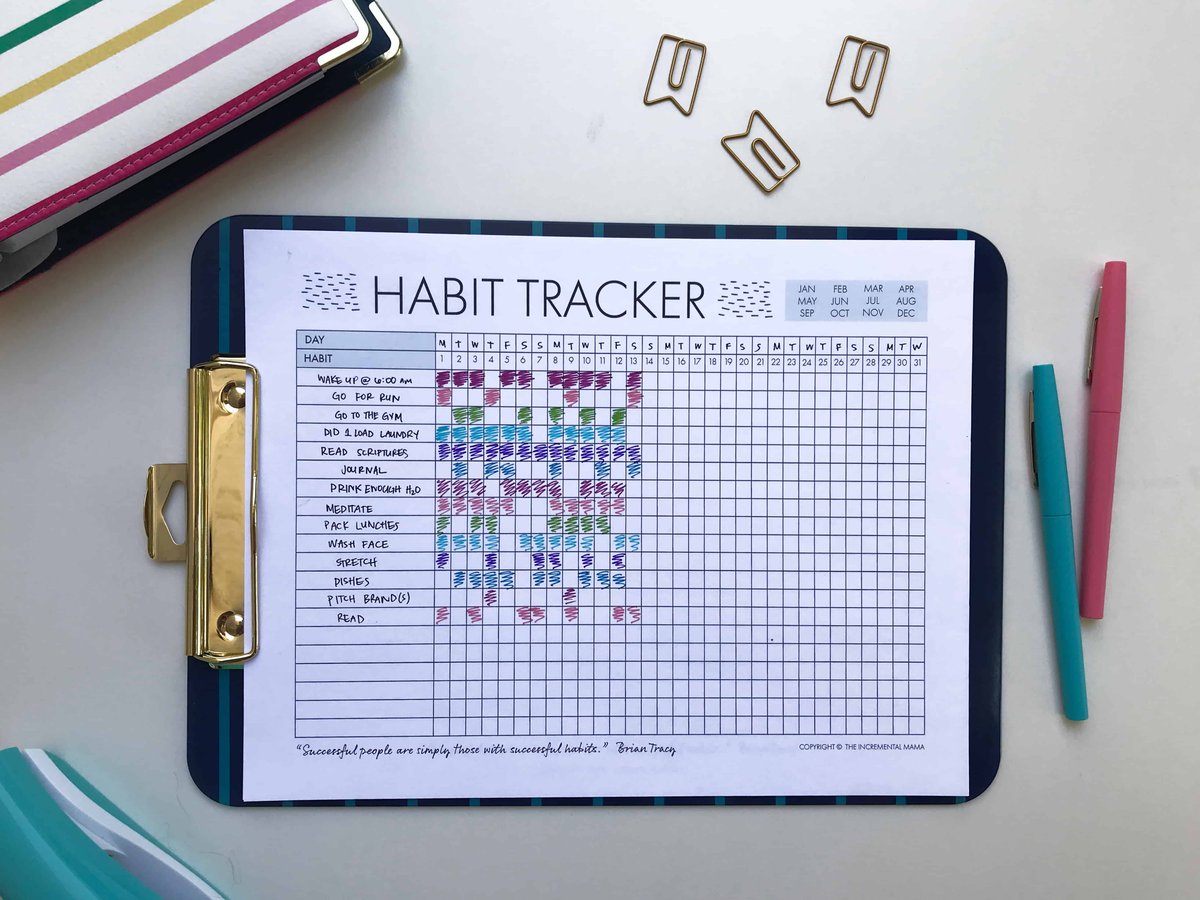
This is the most common and straightforward. You simply list your habits vertically on one side and the days of the month horizontally across the top.
- How it works: Each day, you fill in the box (with an ‘X’, a dot, or a color) if you completed the habit.
- Best for: Daily habits, general overview of consistency.
- Example: A monthly spread with “Meditate,” “Drink Water,” “Read,” “Exercise” listed, and 31 columns for the days.
The Minimalist Approach
Clean lines, basic shapes, and limited color palettes make these trackers efficient and visually calming.
- How it works: Often just a simple grid or a series of dots. Focus is entirely on the tracking, not decoration.
- Best for: Those who prefer function over intricate art, or who are short on time.
- Example: A page with just the habit names and small squares next to each for daily checkmarks, or a small dot-grid where each row is a habit and each column a day.
Creative Visual Trackers
These are where your artistic side can truly shine, making tracking a joyful experience.
- How it works: Each day’s completion adds to a larger picture or theme. Think of a garden that grows, a mandala that fills in, or a butterfly gaining its colors.
- Best for: Highly visual learners, those motivated by aesthetics, specific long-term goals.
- Example 1: The “Take the Cake” Tracker: Each slice of a drawn cake represents a day. Color in a slice when you complete a habit (or group of habits).
- Example 2: Growing a Plant: Draw a plant with 30-31 leaves/flowers. Color one in each day you complete your habit, watching your plant “grow” over the month.
- Example 3: Mandala or Moon Phase: Each segment of a mandala or moon represents a day. Color it in upon habit completion.
Graph and Grid Combinations
Often used for tracking multiple variables or showing progress over time with more detail.
- How it works: One axis might be days, the other a scale (e.g., mood from 1-5, hours of sleep). You plot a point or fill a bar.
- Best for: Tracking quantitative data like sleep hours, mood, water intake, or combining habits with other metrics.
- Example: A line graph tracking hours of sleep each night, or a bar graph showing daily water consumption.
Specific Purpose Trackers
Tailored designs for very particular habits or multi-faceted goals.
- How it works: The layout is optimized for the specific information.
- Best for: Complex habits like detailed financial logging, pet care, or project management.
- Example 1: Meditation Tracker: A simple grid where you log duration, type of meditation, and perhaps a quick mood note for each session.
- Example 2: Savings Tracker: A visual representation of a jar or a mountain, where you color in segments as you reach saving milestones.
- Example 3: Reading Tracker: A bookshelf where you list books and color them in as you finish, or a “pages read” line graph.
Time Period Trackers (Daily, Weekly, Monthly, Yearly)
These simply organize your tracking by the relevant frequency.
- Daily: A small box on your daily spread to mark specific immediate tasks.
- Weekly: A spread showing the 7 days, often used for habits like “grocery shopping” or “laundry.”
- Monthly: The most common, as detailed above (calendar grid, creative themes).
- Yearly: A “future log” style spread where each line is a habit and each column is a month, allowing you to see annual consistency. This is excellent for long-term habits like “annual check-up” or “financial review.”
The Habit Sticking Playbook: Making Your Tracker Work for You
A beautiful tracker is great, but a used tracker is what truly drives change. Here’s how to ensure your habit tracker examples become effective tools:
- Automate Your Reminders: Don’t rely solely on memory. Use your phone’s alarms, calendar alerts, or even sticky notes on your mirror. Pair new habits with existing ones (e.g., “After I brush my teeth, I will journal”).
- Define Your “Why”: Before you even draw the first line, ask yourself why this habit matters. Connecting to a deeper purpose (“I want to read daily to expand my knowledge for my dream job,” not just “I want to read”) transforms a chore into a meaningful ritual.
- Simplify Radically: The biggest hurdle is often starting. Make the habit so tiny you can’t refuse it. Instead of “read a chapter,” try “read one paragraph.” For exercise, “do one push-up.” Once you start, momentum often takes over.
- Minimize the Steps to Start: Reduce any friction points. If you want to draw, keep your journal and pens on your desk. For exercise, lay out your clothes the night before. The easier it is to begin, the more likely you are to do it.
- Be Specific and Consistent: Vague goals lead to vague results. “Exercise” is less effective than “30-minute brisk walk at 7 AM, five days a week.” Consistency in time and context helps hardwire the habit into your brain.
- Start Small and Build: Don’t try to overhaul your entire life at once. Pick one or two habits, master them, and then gradually add more. Small, sustainable steps are far more powerful than ambitious, short-lived sprints.
- Optimize Your Environment: Design your surroundings to support your habits. If you want to drink more water, keep a full water bottle visible on your desk. If you want to avoid screens, plug your phone in another room overnight.
- Involve Others for Support: Share your goals with a friend, family member, or accountability partner. Knowing someone else is aware of your efforts can provide an extra layer of motivation and support.
- Never Give Up on the Streak (Mostly): If you miss a day, don’t throw in the towel. The “never miss twice” rule is powerful. Just pick up where you left off. Consistency over time, even with a few bumps, is what truly builds lasting habits.
Quick Answers to Common Habit Tracking Questions
How many habits should I track at once in my bullet journal?
Start small. One to three habits are ideal when you’re first getting started or trying to establish new, significant routines. As they become more ingrained, you can gradually add more. Overloading your tracker can lead to overwhelm and burnout.
What if I miss a day or a few days? Should I just give up?
Absolutely not! A missed day is not a failure; it’s a data point. The “never miss twice” rule is incredibly helpful here. Don’t let one lapse derail your entire effort. Simply acknowledge the miss, and get right back on track the next day. A bullet journal allows for this flexibility – you can even use a different color to mark a “restarted” streak.
My tracker looks messy. Does it have to be perfect?
No! Your habit tracker is a tool for you, not a work of art for public display (unless that’s what motivates you!). The most effective tracker is the one you actually use. Focus on clarity and function over aesthetic perfection. Embrace the imperfections; they tell the story of your progress.
What’s the best time to fill out my habit tracker?
Consistency is key. Many people prefer to fill out their daily habits at the end of the day as part of their evening wind-down routine, or first thing in the morning for habits completed the previous day. Find a time that naturally fits into your schedule and commit to it.
Can I track “bad” habits I want to stop, like smoking or excessive social media?
Yes, absolutely! Instead of tracking completion, you track non-completion. For example, you might mark an ‘X’ on days you didn’t smoke or days you stayed off social media during a specific time block. This is often called a “negative habit tracker” or an “avoidance tracker.”
Should I use a digital habit tracker instead of a bullet journal?
Both have merits, but the bullet journal offers unique advantages:
- Sensory Engagement: The act of physically writing and coloring can enhance memory and commitment.
- Customization: Unparalleled freedom in design and layout, making it truly personal.
- Distraction-Free: No notifications or app switching, just you and your goals.
- Mindfulness: The process of journaling and tracking can become a meditative practice.
If digital tools work for you, that’s great, but for a deeply personal and customizable experience, the bullet journal shines.
Your Next Step: Design Your Own Habit Tracker Example
You’ve explored the diverse landscape of habit tracker examples, from simple checkmarks to intricate visual designs. The core takeaway is this: the most effective tracker isn’t about rigid rules or artistic prowess; it’s about consistency, personalization, and a clear understanding of your “why.”
Start small. Pick just one or two habits from the examples above that truly resonate with your current goals. Grab your bullet journal, a pen, and perhaps a few colored markers. Sketch out a simple calendar grid, or try a small thematic element. Don’t overthink the first design; you can always refine it next month. The act of beginning, of putting pen to paper and making that first mark, is where real change starts. Your journey to consistent habits begins today.

Through this website, I share simple, science-backed tips for low impact health whether it's gentle fitness routines, stress-free wellness habits, or eco-friendly lifestyle changes. My goal is to make healthy living more accessible, sustainable, and kind to both our bodies.
- Healthy Eating Habits to Fuel Your Body for Lasting Vitality - May 9, 2026
- Inspirational Health Related Sayings for Your Best Self - May 8, 2026
- Healthy Mind Quotes for Cultivating Peace and Mental Strength - May 7, 2026