Struggling to make those good intentions stick past the first week of the month? A monthly habit tracker printable offers a powerful, low-tech solution to turn fleeting aspirations into ingrained routines. Imagine watching a blank grid steadily fill with checkmarks, visually affirming your progress day after day. This simple yet profound act of marking progress isn’t just satisfying; behavioral studies show it can increase your success rates by an impressive 70%, making lasting habit formation less about willpower and more about consistent, visible action.
Whether you’re a first-timer feeling overwhelmed by digital apps or someone who thrives with a pen and paper, a printable monthly tracker simplifies the journey. It’s about clarity, consistency, and celebrating every small victory on the path to a better you.
At a Glance: Your Takeaways on Monthly Habit Trackers
- Visual Motivation: Witness daily progress on paper, boosting consistency and long-term success.
- Strategic Structure: Understand the key components of a comprehensive monthly tracker, from grids to reflection spaces.
- Step-by-Step Implementation: Learn how to set up, track daily, and review monthly for maximum impact.
- Avoid Common Pitfalls: Discover how to sidestep mistakes like tracking too many habits or vague goal setting.
- Personalize for Power: Master customization techniques like color-coding and habit stacking to fit your unique lifestyle.
- Long-Term Mastery: Transition from monthly tracking to ingrained habits and continuous personal growth.
Why a Monthly Habit Tracker is Your Secret Weapon for Consistency
While daily, weekly, and even yearly trackers each have their place, the monthly format strikes a perfect balance. It’s long enough to reveal patterns and build momentum, yet short enough to feel manageable and prevent burnout. A monthly tracker provides a snapshot of your entire month’s effort on a single page, making it incredibly easy to see where you’re excelling and where you might need to adjust your strategy.
This paper-and-pen method taps into our natural preference for tangible interaction. There’s a satisfying feeling in physically marking off a completed habit, a small ritual that reinforces the action itself. Unlike a digital app that can hide progress behind screens and menus, a monthly tracker sits visibly on your desk or fridge, a constant, gentle reminder of your commitments and an undeniable record of your dedication. It’s a foundational tool in the broader journey to Build lasting good habits and cultivate a life aligned with your goals.
Deconstructing Your Monthly Habit Tracker Printable: Key Components
A truly effective monthly habit tracker isn’t just a grid; it’s a thoughtfully designed system. Understanding its parts helps you utilize it to its full potential.
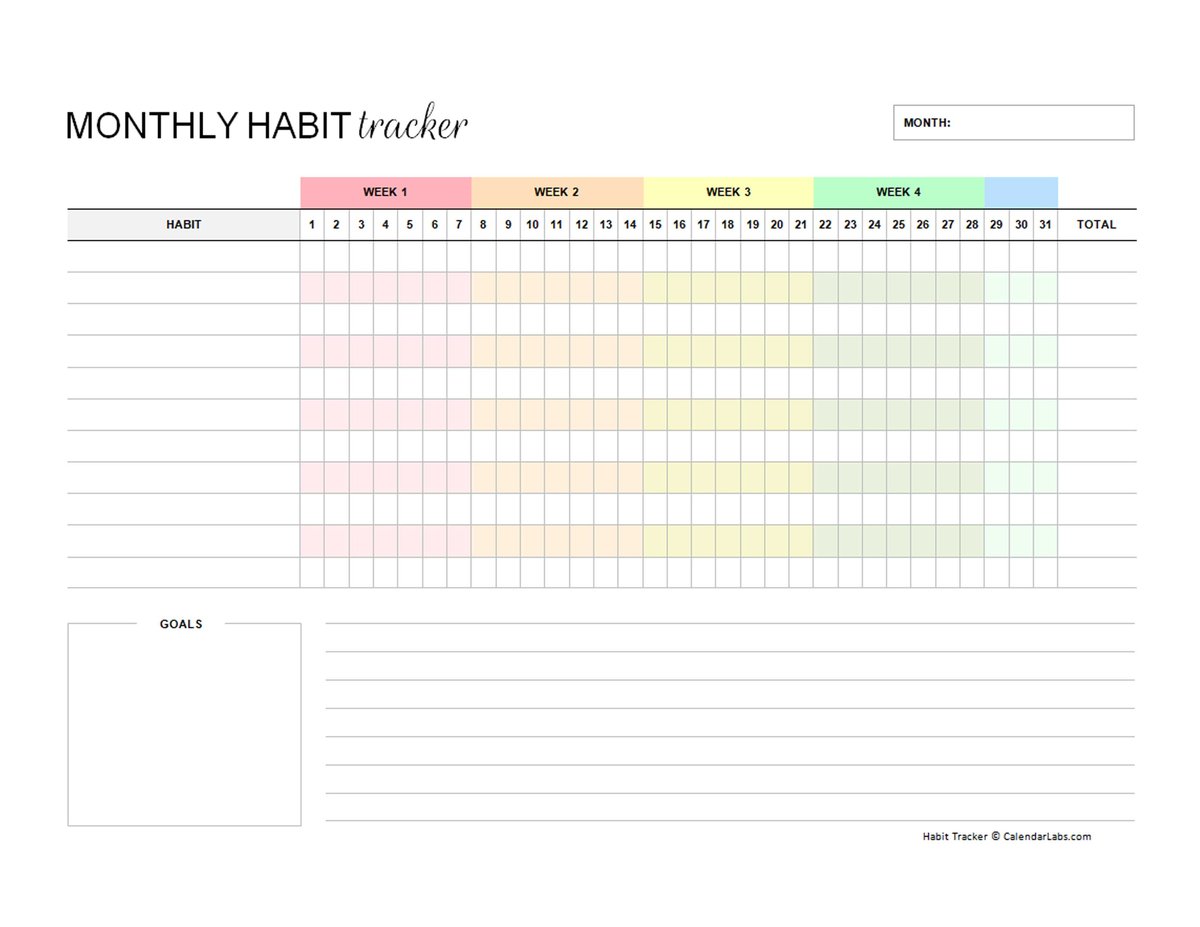
Most comprehensive monthly habit tracker printable designs include:
- Header for Month and Year: Essential for organization and archiving.
- Habit List: Numbered slots (often 5-7) to clearly write down the specific habits you’re tracking. This forces specificity, which is crucial for success.
- 31-Day Tracking Grid: The core visual element. Each row represents a habit, and each column represents a day of the month. Some designs subtly highlight weekends for easier navigation.
- Legend System: A clear key for marking progress.
- ✓ (Completed): The goal! You did it.
- ◗ (Partial): You made an effort, but didn’t hit the full target. Important for acknowledging progress without perfectionism.
- ✗ (Missed): You skipped it. Crucial for honest self-assessment, not self-judgment.
- — (Not Applicable): The habit wasn’t relevant that day (e.g., a “workday” habit on a weekend).
- Monthly Totals Column: A space at the end of each habit row to count how many times you completed, partially completed, or missed a habit. This provides immediate data for reflection.
- Reflection & Notes Section: Lined space at the bottom for qualitative insights. This is where you connect the “what” with the “why,” noting what worked, what didn’t, and how you felt.
Case Snippet: Sarah started with a basic monthly tracker for “Drink 8 glasses water,” “Read 20 pages,” and “Meditate 10 mins.” By using the ‘partial’ mark for days she drank 4 glasses or read 10 pages, she avoided the all-or-nothing trap. Her “notes” section revealed that early morning meditation was easier than evening, prompting a schedule adjustment for the next month.
Your Monthly Tracker Playbook: From Setup to Success
Setting up your monthly habit tracker printable takes just a few minutes, but consistent daily engagement is where the magic happens.
Step 1: Laying the Foundation (Beginning of the Month)
- Print Your Tracker: Choose a design you like and print it on standard US letter (8.5×11 inch) or A4 paper. Most templates are free for personal use.
- Fill in the Essentials: Write the current Month and Year at the top.
- Define Your Habits: This is critical. Instead of “exercise more,” write “Walk 30 minutes daily.” Instead of “eat better,” write “Eat 5 servings of vegetables.” Aim for 2-3 habits if you’re a beginner, or 3-5 if you have some tracking experience. More than 5 often leads to overwhelm.
- Health: “Drink 64oz water,” “Sleep 7.5 hours,” “Meditate 15 mins.”
- Personal Growth: “Read 20 pages,” “Journal 10 mins,” “Practice [skill] for 30 mins.”
- Productivity: “Clear inbox,” “Review daily priorities,” “No social media after 8 PM.”
- Understand Your Legend: Familiarize yourself with the symbols (✓, ◗, ✗, —) and commit to using them honestly.
Step 2: Daily Engagement & Tracking (Throughout the Month)
- Place it Strategically: Put your tracker where you’ll see it multiple times a day. Your bathroom mirror, coffee station, or workspace are ideal. The visual cue is powerful.
- Mark Progress Consistently: The best time to mark is usually in the evening, as part of a winding-down routine, or first thing in the morning for habits completed the previous day. Review each habit, assess your effort, and mark the corresponding square for the day.
- Embrace Imperfection: If you miss a day, just mark it with an ‘✗’. The goal is consistency over perfection. One missed day doesn’t erase your progress; it’s simply data. Adopt a “don’t break the chain” mentality, but if the chain does break, just start a new one tomorrow.
Step 3: Monthly Review & Planning (End of the Month)
- Count Your Totals: At the end of the month, go through each habit row and tally the number of ✓, ◗, and ✗ marks in the “Monthly Totals” column.
- Calculate Success Rates: A quick way to quantify your progress. For example, if you aimed for 30 days of a habit and achieved 25 ‘✓’ marks, that’s an 83% success rate!
- Reflect and Adjust: Use the notes section to ask yourself:
- “Which habits went well, and why?”
- “Which habits struggled, and what were the barriers?”
- “What patterns do I notice (e.g., always miss on Tuesdays, or after late nights)?”
- “What adjustments can I make for next month’s tracker?”
- Weekly Mini-Reviews: Consider scheduling 10 minutes weekly to glance at your tracker. This helps you catch issues early rather than waiting until month-end.
Elevating Your Tracking Game: Customization & Advanced Strategies
A basic monthly habit tracker printable is a great start, but tailoring it to your needs can significantly boost its effectiveness.
- Color Coding for Clarity: Assign a different color to each habit category (e.g., green for health, blue for productivity, yellow for personal growth). This makes your tracker visually engaging and helps you quickly grasp your overall balance.
- Example: If you see a lot of green and blue marks but very few yellow, you know to focus more on personal growth next month.
- Prioritize High-Impact Habits: If you have 5 habits, mark your top 1-2 most crucial ones with a star or a different symbol. This keeps your focus sharp on what truly matters most for your goals.
- Habit Stacking: Link a new habit to an existing, established routine. This leverages your brain’s existing neural pathways.
- Example: “After I brush my teeth (existing habit), I will meditate for 5 minutes (new habit).” Write this cue directly on your tracker or in your notes.
- Environmental Cues: Place your tracker not just visibly, but near the items or location related to the habit.
- Example: For “Drink 64oz water,” place the tracker near your water bottle or the kitchen sink.
- Reward Systems: Design small, non-food rewards for hitting weekly or monthly milestones.
- Example: “If I hit 80% completion for ‘Read 20 pages’ this week, I’ll buy that new book I’ve wanted.”
- Plan for Obstacles: Before the month even begins, brainstorm potential barriers for each habit and pre-plan solutions.
- Example: Obstacle: “Too tired to exercise after work.” Solution: “Lay out gym clothes the night before, or plan a shorter, intense workout instead.”
Dodging the Landmines: Common Mistakes to Avoid
Even with the best intentions, certain pitfalls can derail your habit tracking journey.
- Tracking Too Many Habits at Once: This is the most common mistake. Overwhelm leads to abandonment. Stick to 2-3 for beginners, 5 max for experienced trackers. Your willpower is a finite resource.
- Vague Goals: “Be healthier” cannot be tracked. “Walk 30 minutes every weekday morning” can. Precision is your friend.
- Perfectionism Paralysis: Missing a day feels like a failure, so you stop tracking altogether. Remember: consistency beats perfection. A single ‘✗’ doesn’t negate all your ‘✓’s. Just get back on track the next day.
- Forgetting to Review Progress: The data on your tracker is invaluable. If you just mark squares without reviewing monthly patterns, you’re missing opportunities to learn, adapt, and improve. Dedicate time to reflection.
- Ignoring the “Why”: If you don’t connect your habits to a larger goal or purpose, motivation wanes. Regularly remind yourself why these habits matter to you.
Beyond the Month: Sustaining Habits for Life
A monthly habit tracker printable is an excellent springboard, but true success lies in evolving these habits into automatic behaviors.
- Track Streaks & Records: Challenge yourself to maintain the longest streak possible. Documenting your longest run of consecutive successes is a powerful motivator.
- Review Quarterly Patterns: Step back every three months to look for bigger trends. Do certain habits consistently drop off during specific seasons or busy periods? This allows for strategic adjustments.
- Celebrate Anniversaries: Mark 30, 60, and 90-day milestones. These are significant achievements that deserve recognition and reinforce the value of your efforts.
- Graduate Habits: After 3 months of consistent, high-percentage tracking, a habit might feel “autopilot.” When a habit is ingrained, consider graduating it from your active tracker, freeing up space to focus on developing new behaviors. This keeps your tracker fresh and focused on growth, not just maintenance.
Case Snippet: John consistently tracked “Write 500 words” for three months, achieving over 85% completion each time. He noticed he no longer needed the visual reminder; writing had become part of his morning. He ‘graduated’ the writing habit and added “Learn 10 Spanish words” to his tracker, using the newfound capacity.
Quick Answers to Your Monthly Habit Tracker Questions
Q: How many habits should I track on a monthly printable?
A: Start small! For beginners, 2-3 habits are ideal. If you’re more experienced, track a maximum of 5. Overwhelming yourself with too many habits is a common reason for giving up.
Q: What’s the best time to fill out my monthly habit tracker?
A: The most effective time is usually in the evening, during your wind-down routine, to reflect on the day’s habits. Alternatively, you can track morning habits right after completing them or review the previous day’s habits first thing in the morning. Consistency in your tracking time is key.
Q: What if I miss a day or a few days? Should I give up?
A: Absolutely not! Missing a day is normal and part of the process. Simply mark an ‘✗’ and commit to getting back on track the next day. The focus should be on overall consistency, not perfection. One missed day doesn’t ruin your progress; it’s just data.
Q: Can I use different symbols than the standard checkmark/X?
A: Yes, customize your legend! As long as you understand what your symbols mean, feel free to use stars, dots, or color fills. Just make sure your system is clear and consistent for you.
Q: Where can I find a good monthly habit tracker printable?
A: Many websites offer free, printable PDF templates for personal use. A quick search for “monthly habit tracker printable” will yield numerous options to choose from, often designed to fit standard US letter or A4 paper.
Your Monthly Habit Tracker Playbook: Quick Start Guide
Ready to transform your intentions into consistent actions? Here’s a simple action plan to get your monthly habit tracker printable working for you right now:
- Choose Your Core 2-3 Habits: Be hyper-specific. “Meditate 10 minutes daily,” “Drink 64oz water,” “Read 15 pages.”
- Print and Place: Get your favorite template, fill in the month, and put it somewhere you can’t miss it (fridge, desk, mirror).
- Daily Check-in: Each evening, honestly mark your progress for each habit using your legend (���, ◗, ✗).
- Weekly Adjustment: Take 5-10 minutes each week to glance at your tracker. Are you hitting most days? If not, what small change can you make for the coming week?
- Monthly Reflection: At month’s end, tally your totals and use the notes section to identify what worked and what to improve for the next month.
The journey of building lasting habits doesn’t have to be daunting. With a well-utilized monthly habit tracker printable, you’re equipped with a visual roadmap, an honest accountability partner, and a powerful motivator to effortlessly build the habits that shape the life you want to live. Start today, and watch your progress unfold, one marked square at a time.

Through this website, I share simple, science-backed tips for low impact health whether it's gentle fitness routines, stress-free wellness habits, or eco-friendly lifestyle changes. My goal is to make healthy living more accessible, sustainable, and kind to both our bodies.
- Healthy Eating Habits to Fuel Your Body for Lasting Vitality - May 9, 2026
- Inspirational Health Related Sayings for Your Best Self - May 8, 2026
- Healthy Mind Quotes for Cultivating Peace and Mental Strength - May 7, 2026